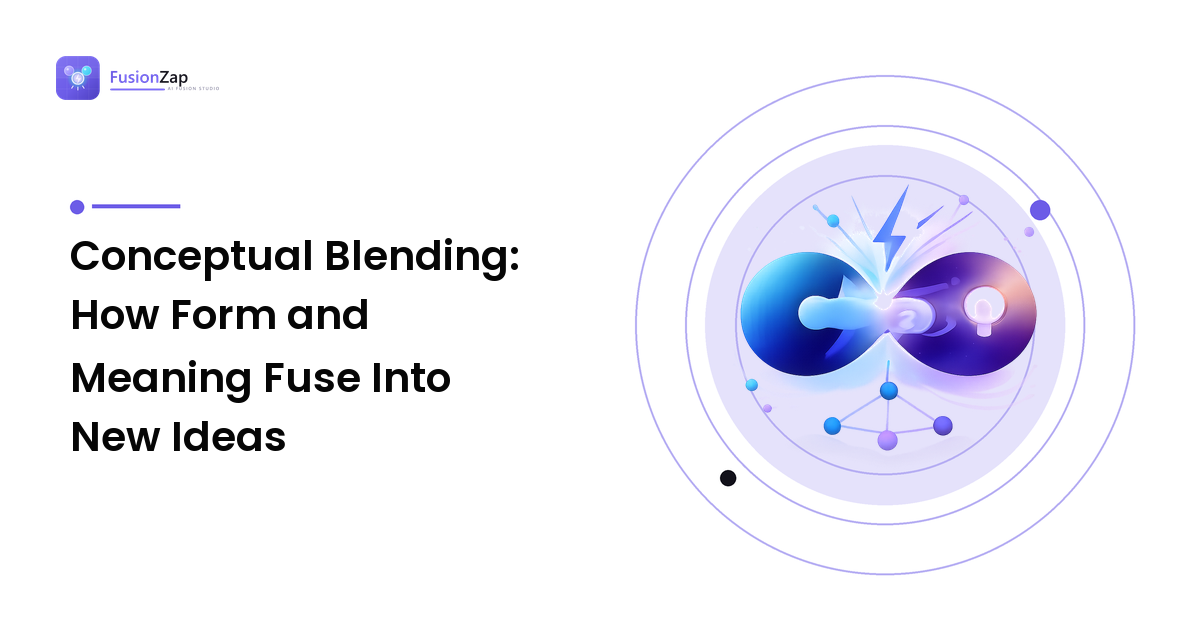
Conceptual blending is the mental operation behind every idea merge: two concepts are mapped onto each other, their shared skeleton identified, and selected structure from both projected into a new blended space with properties neither input had. Blends fuse form (word shapes, visual shapes) or meaning (roles, logic, causality) — the good ones fuse both.
That distinction is the whole game. Most merges that come out mushy are form blends wearing a meaning blend's clothes. This guide builds the model piece by piece, names the four blend types, and shows how each one becomes a prompt you can actually run.
What is conceptual blending, exactly?
The theory comes from cognitive scientists Gilles Fauconnier and Mark Turner, who argued that blending is not a rare creative flourish but a routine, largely unconscious operation the mind runs constantly — in metaphor, humour, design, and ordinary speech. The classic account uses four mental spaces:
- Input space 1 — your first concept, with its own elements, roles, and relations.
- Input space 2 — your second concept, same.
- Generic space — the abstract structure both inputs share. This is what makes them mappable at all: a common role, a common goal, a common shape of events.
- The blend — a new space that receives selected structure from both inputs and then develops emergent structure: logic that exists only in the blend.
That fourth point separates blending from mere combination. "Computer desktop" is a blend: folders, files, a trash can, a surface — plus behaviours (dragging a file into a folder, stacking windows) belonging to neither real desks nor raw file systems. The emergent structure is the value.
Three moves happen inside the blend: composition (bringing elements together), completion (your knowledge fills in the implied rest), and elaboration — "running the blend," letting the new space play out its own consequences. Elaboration is where the payoff lives, and it is the step people skip.
How is blending form different from blending meaning?
Form blends fuse surfaces. Portmanteau words — brunch, podcast, smog — splice the shapes of two words. Visually, a form blend is a logo where a coffee bean silhouette doubles as a moon, or a photo restyled so its textures come from somewhere else entirely. Form blends are fast, legible, and often delightful.
Meaning blends fuse structure. "This deadline is a wall" imports the causal logic of a physical obstacle into a scheduling problem, and the logic keeps generating: you can hit it, go around it, run out of runway before it. No word shapes merged; the reasoning did.
Three practical consequences:
- Form without meaning is a pun. Fine for a headline, thin for a concept. A merge that works only because two words rhyme will not survive contact with a brief.
- Meaning without form is invisible. A structurally brilliant blend with no memorable surface — no name, no image, no phrase — never gets shared.
- The strongest blends carry both. Podcast fused word shapes and imported broadcast logic into on-demand audio. That is why it stuck.
The anchor-and-modifier method in our idea fusion guide is a manual procedure for producing meaning blends and then giving them form. Blending theory tells you why it works — and why skipping the attribute cross-map produces a merge that is all surface.
What are the four types of blend networks?
Fauconnier and Turner classify blend networks by how much organising structure each input contributes. This is the most useful single distinction in the theory, because it predicts how hard the blend will be to build and how surprising it will be to encounter.
| Network type | What each input contributes | Rough example | Creative use | Difficulty |
|---|---|---|---|---|
| Simplex | One input supplies a frame, the other supplies values to fill it | "Paul is the father of Sally" — kinship frame plus two people | Templating, personas, filling a format with new content | Low |
| Mirror | Both inputs share the same organising frame | Two chess players in different centuries compared move for move | Comparisons, versus formats, benchmarking narratives | Low |
| Single-scope | Both have frames; only one frame organises the blend | "The CEO knocked out the competition" — boxing frame organises business | Metaphor-led campaigns, explainers, analogies | Medium |
| Double-scope | Both frames project structure; they may even clash | The computer desktop; a workout app that runs on quest logic | Genuinely new formats, products, and brand concepts | High |
Read it as a difficulty ladder. Simplex and mirror blends are cheap and safe. Single-scope is the workhorse of good copy — one thing understood through the frame of another. Double-scope is where new categories come from, and it is hard precisely because the two frames fight; the clash is not a bug to smooth over but the source of the emergent structure.
If your merge feels flat, you are a rung lower than you think. If it feels incoherent, you attempted double-scope without a real generic space.
How do you find the generic space between two concepts?
Without a generic space the two inputs will not map, no matter how hard you prompt. A short procedure:
- State each input as a small scene, not a noun. "A coffee roaster" is a noun; "a person selecting beans by smell and grading each batch" is a scene with roles.
- List the roles — who acts, who receives, what changes, what constrains.
- Find the correspondences. Which actor in scene A plays the part of which in scene B? One or two solid ones are enough.
- Name the abstraction in one line. "Both are: an expert filtering abundance down to a confident choice."
- Project selectively. Frame from one input, surprising elements from the other, deliberately drop the rest.
Step 5 is the discipline. Blends fail from over-projection far more often than under-projection — pull everything across and you get a beige average, not a new space.
How do you turn a blend into an AI prompt?
Generators are good at composition and completion, and weak at elaboration — they will happily merge surfaces and stop. So the prompt has to carry the structure the model will not infer:
"Input A frame: [scene, roles, causal logic]. Input B frame: [scene, roles]. Shared abstraction: [one line]. Build a double-scope blend: the blend must use A's roles and B's causal logic, and must produce at least one consequence that is true in neither A nor B. Give 5 distinct blends, one sentence each, and name the emergent consequence for each."
That last clause matters most: asking explicitly for the emergent consequence forces elaboration instead of a splice. The role-assignment and weighting mechanics behind prompts like this are covered in our fusion prompt guide.
The same structure transfers to visuals. In image and style fusion, the photo supplies the subject frame and the style supplies the surface — a single-scope blend, which is why it is reliable. Double-scope image blends, where both references contribute organising logic, are far less predictable and need several rounds of culling. In brand fusion, the blend is a whole concept set: frame from one aesthetic, energy from another, one line of shared abstraction holding it together.
Two caveats. Models mirror human failure modes — expect over-projected mush and pun-level form blends among the candidates, and treat curation as your job. And blending someone else's specific expression is not the same as blending concepts: concepts and frames are fair territory, a living artist's signature style used for commercial passing-off is not, and the legal questions around AI training data remain genuinely unsettled. Check the current terms of whatever tool you use — commercial rights differ per service and change often — and label AI-assisted work when you publish.
FAQ
What is conceptual blending in simple terms? It is the mental move of taking two concepts, finding what they have in common, and building a third mental space that borrows selectively from both and then develops its own logic. That extra logic — the "emergent structure" — is what makes a blend feel new rather than merely combined.
What is the difference between conceptual blending and metaphor? Metaphor is one output of blending — typically a single-scope blend where one frame organises understanding of another. Blending is broader, covering cases metaphor does not, including double-scope blends where both frames contribute structure.
What are the four spaces in blending theory? Two input spaces (your source concepts), a generic space (the abstract structure they share, which lets them map onto each other), and the blended space (the new concept built from selected projections plus whatever emerges once you run it).
Why do my concept blends come out mushy? Usually over-projection: too much structure pulled from both inputs, so the result averages instead of merging. Fix it by naming one input's frame as the organiser, transplanting one or two elements from the other, and dropping the rest. A weak generic space is the second common cause.
Can AI tools do conceptual blending? Generators produce blend candidates quickly when you supply the frames and shared abstraction explicitly, but they tend to stop at surface composition unless you ask for the emergent consequence. Treat output as raw material to curate, and verify anything you publish yourself.
The bottom line
Blending is not mysticism — it is a procedure: two inputs, one shared abstraction, selective projection, then elaboration. Diagnose which network type you are building, insist on the emergent consequence, and give the meaning blend a form worth remembering. That two-inputs-in, new-concept-out operation is what FusionZap is building as a one-click fusion generator, with recipes for merging ideas, brands, styles, and images. Take your last flat merge, find its generic space, and run the blend properly.